If you're exhibiting at Tokyo Big Sight and you're organising your printing from overseas, this guide covers what you need to know: what to print, what sizes work, how far ahead to order, and how to get everything delivered to your booth without ever visiting a print shop.
Tokyo Big Sight is Japan's largest exhibition centre, and for most overseas companies it's the venue where their Japan business actually begins. It's also, quite often, where things go wrong. Not because of the show itself, but because printing gets left until last, and by then you're trying to arrange banners and business cards in a country whose language you don't read, with a deadline that doesn't move.
This is the guide we wish every exhibitor had read three weeks earlier.
A quick orientation to Tokyo Big Sight
Tokyo Big Sight (officially the Tokyo International Exhibition Center) sits on the Tokyo Bay waterfront in Odaiba. You'll recognise it instantly from the four inverted pyramids of the Conference Tower, which sit beside the East and West Exhibition Halls.
It's a big venue, and it hosts some of the largest events in Asia, from major international trade shows and motor shows to specialist industry expos. Practically speaking, that means two things for you as an exhibitor. First, your booth will be one of hundreds, so what you print is a large part of how you get noticed. Second, delivery logistics matter, because a venue this size has its own receiving procedures and you can't simply turn up with a box under your arm and hope for the best.
What to print for a Tokyo Big Sight booth
Most exhibitors end up needing some combination of the following.
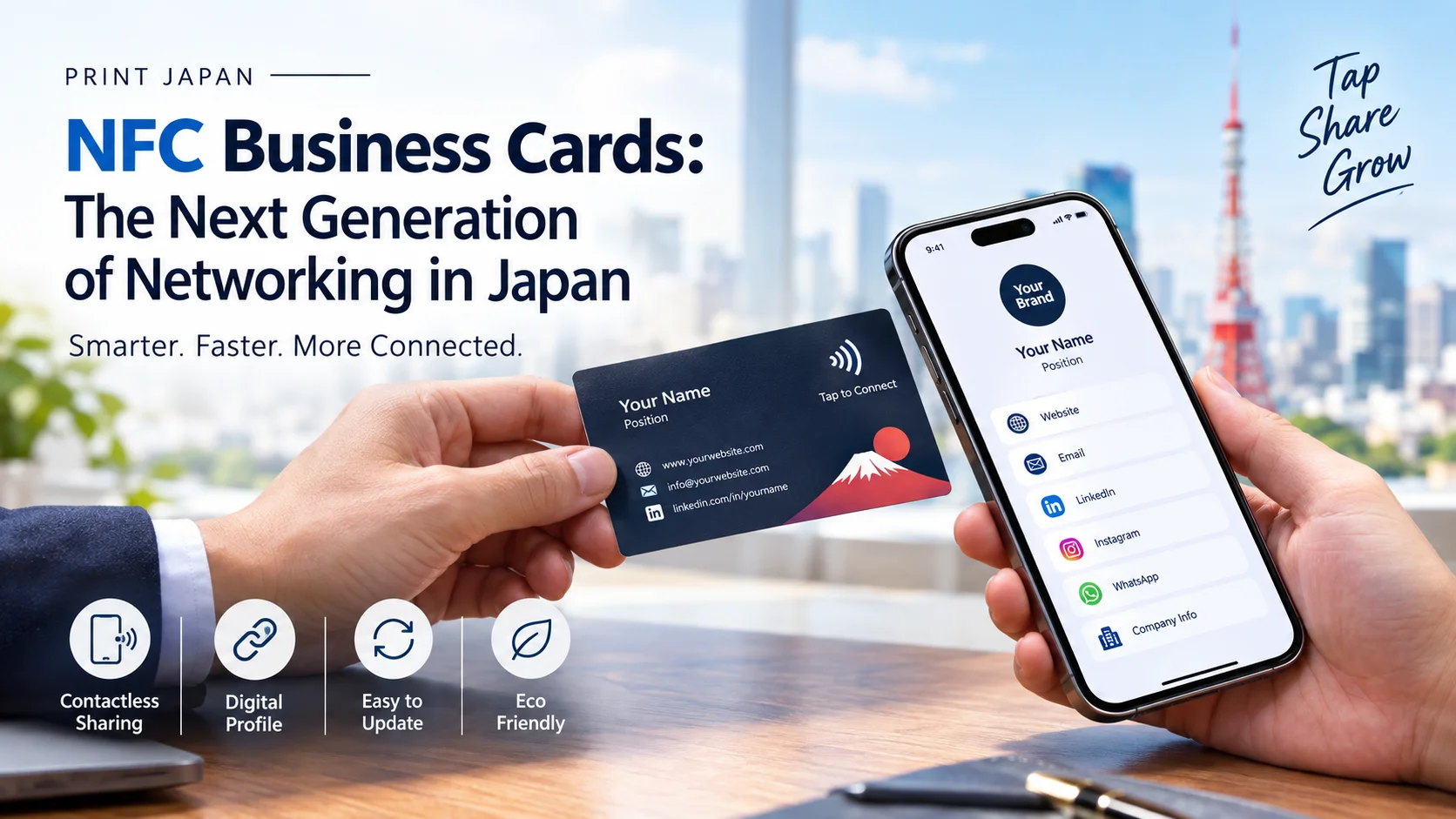
Business cards — and more than you think. Japanese business culture runs on the exchange of meishi, and at a trade show you will hand out far more than you expect. Every conversation begins with a card. Running out on day one is a genuinely common and completely avoidable mistake. The Japanese standard size is 91 by 55 mm, which differs slightly from the usual US or European card, and it's what people here expect to receive. If your card works in both English and Japanese, better still. See our complete guide to business cards in Japan for more on formats and etiquette.
Banner stands. These are the workhorse of booth graphics: quick to set up, easy to transport, and they give your stand vertical presence in a hall full of competitors. There are several types, and which one you want depends on your booth space and how much you'll move it around. There's a full breakdown further down this guide.
Booth panels and backdrops. Larger format graphics that form the back wall of your stand. Worth planning early, because they take the most lead time.
Flyers, leaflets, and brochures. What visitors take away with them. This is where a lot of budget quietly gets wasted, because if your leaflet is English only, most Japanese visitors will glance at it and bin it. A bilingual leaflet, or at minimum a Japanese summary, dramatically changes how many of those conversations turn into anything.
Promo flags (nobori). The tall vertical flags you see everywhere in Japan. They're culturally native, they're cheap, and they pull the eye down an aisle better than almost anything else.
Signage and stickers. Small things that make a booth look finished rather than improvised. If you're running a larger event with entry control, consider custom event wristbands for attendee management.
Choosing the right banner for your booth
Banner stands are the single most common thing exhibitors order, and the type you pick matters more than most people realise. Here's a plain English guide to the options, what each is actually good for, and what they cost.
All prices below are in Japanese yen and exclude tax. Turnaround for banner stands is three to four business days, and for event banners, next day delivery is available if you're up against a deadline.
Roll-up banners
The default choice, and for good reason. The graphic retracts into a weighted aluminium base, so it sets up in about ten seconds, packs into a carry bag, and travels well. If you're doing more than one show, this is the one you'll reuse.
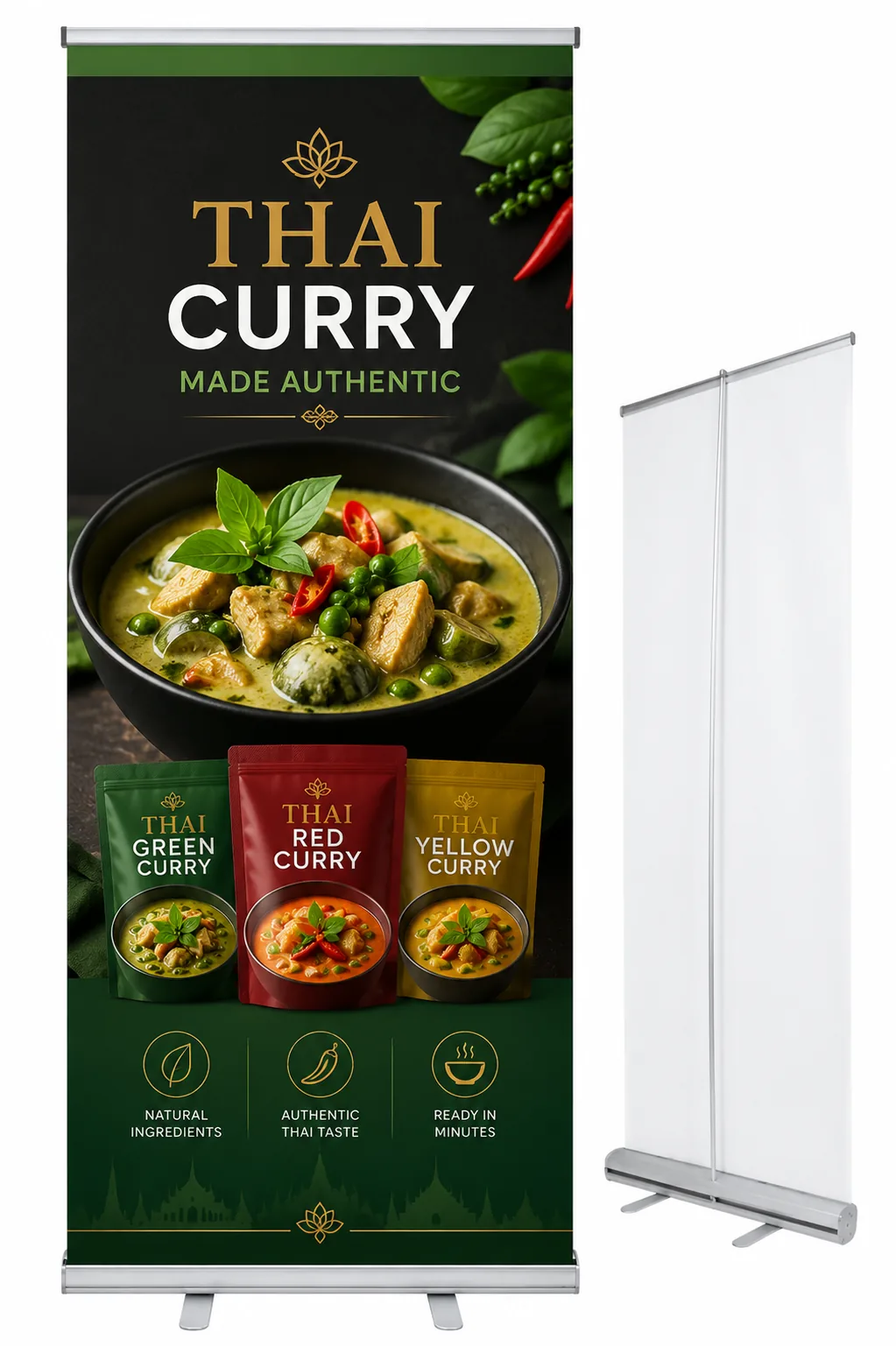
Best for: almost any booth, especially if you'll transport it yourself or use it again at future events.
| Size | Price |
|---|---|
| W600 × H1800 mm | ¥43,741 |
| W850 × H2000 mm | ¥47,192 |
| W1200 × H2000 mm | ¥67,350 |
| W1500 × H2000 mm | ¥95,821 |
| W2000 × H2000 mm | ¥131,722 |
The 850 × 2000 mm size is the most popular for a reason: it's tall enough to be seen across an aisle, narrow enough to fit almost any booth allocation, and light enough to carry with one hand.
X banner stands
A lightweight frame in the shape of an X that the graphic clips onto at the corners. Cheaper than a roll-up and quick to assemble, though slightly less robust for repeated use. There are indoor and indoor/outdoor versions, the latter built to handle wind and weather if any part of your presence is outside the hall.
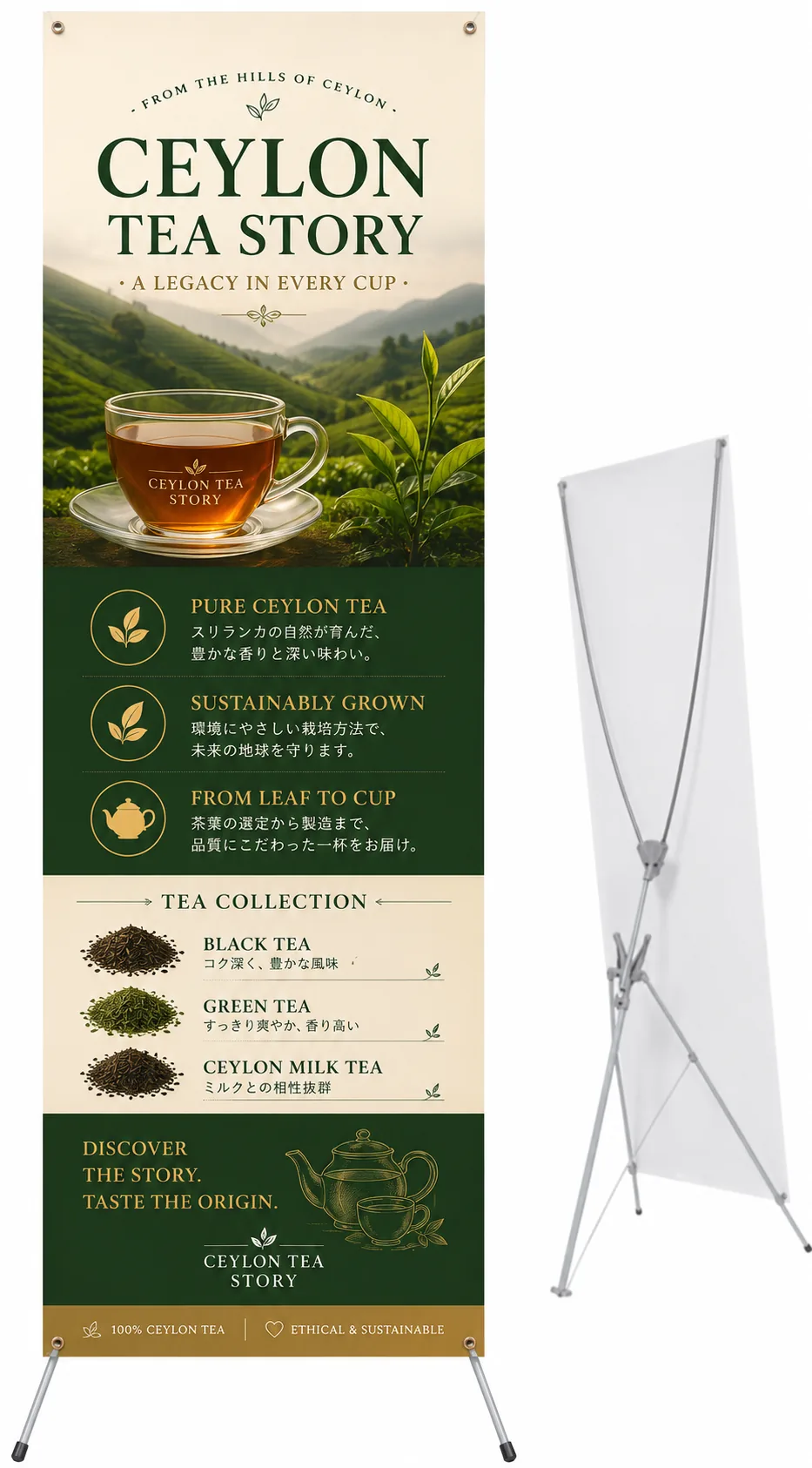
Best for: budget-conscious exhibitors, secondary signage alongside a main banner, or one-off shows.
Indoor
| Size | Price |
|---|---|
| W450 × H1600 mm | ¥28,740 |
| W600 × H1800 mm | ¥28,978 |
Indoor / outdoor
| Size | Price |
|---|---|
| W600 × H1800 mm | ¥35,935 |
| W800 × H1800 mm | ¥46,009 |
| W1000 × H2000 mm | ¥47,929 |
Lightweight X banner (eyelet)
The most affordable option in the range. The graphic attaches through eyelets, keeping the whole thing very light.
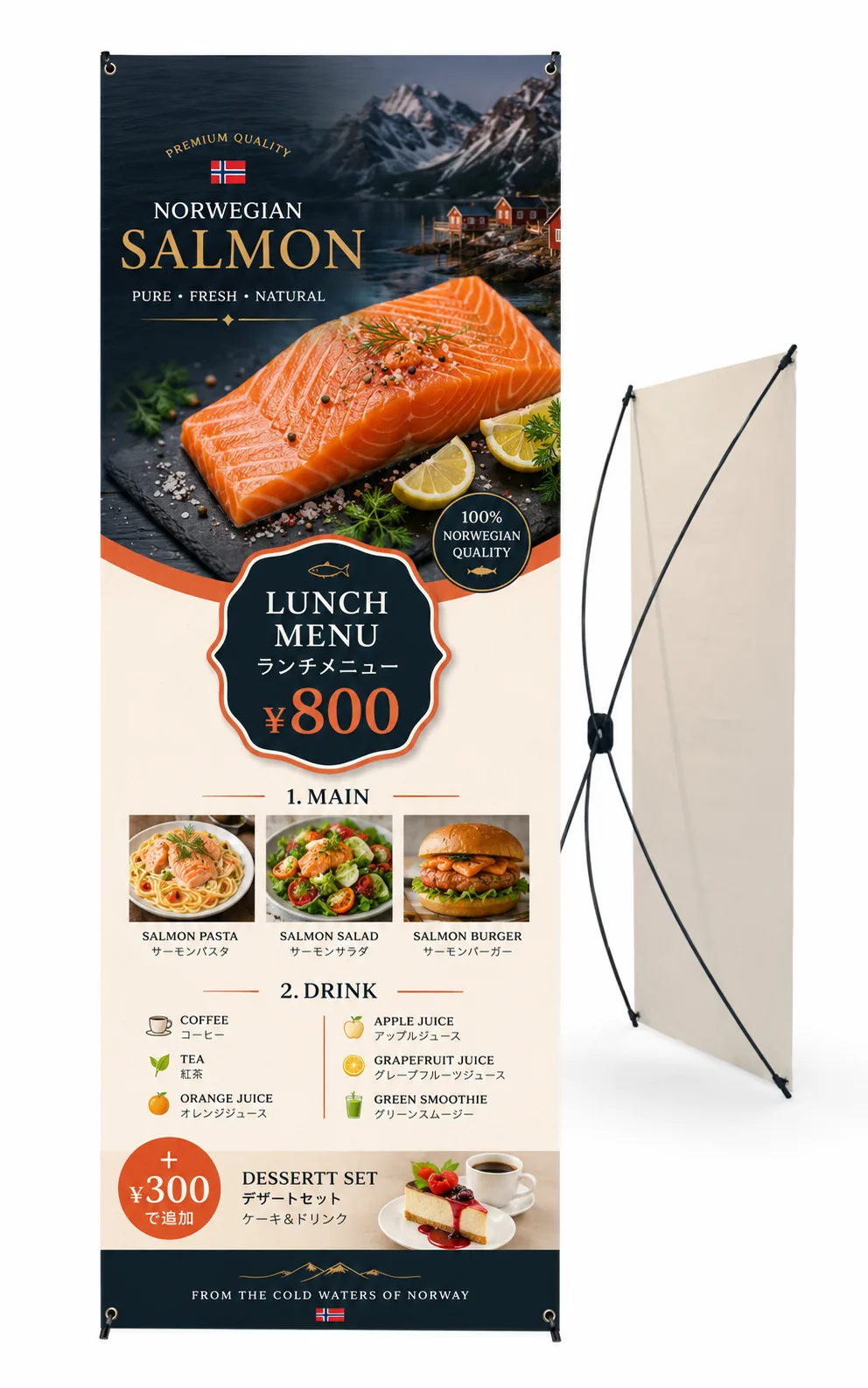
| Size | Price |
|---|---|
| W600 × H1600 mm | ¥25,252 |
I banner stands
A slim, minimal stand where the graphic hangs from a single vertical pole. It takes up almost no floor space, which matters more than you'd think when your booth is small and every square metre is working hard.
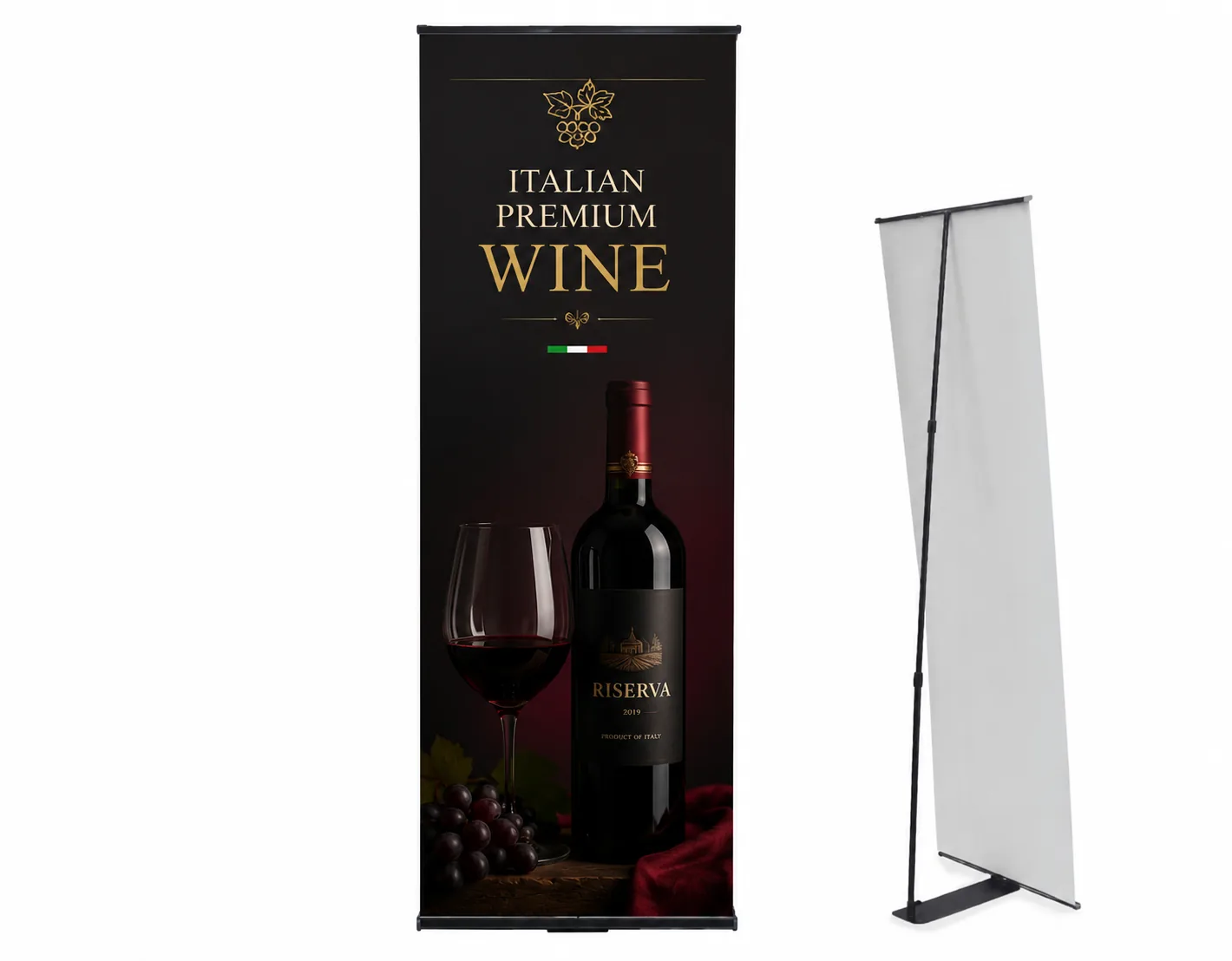
Best for: narrow booths, entrance markers, or flanking a doorway in pairs.
| Size | Price |
|---|---|
| W590 × H2000 mm | ¥21,347 |
| W890 × H2000 mm | ¥25,028 |
T banner stands
A sturdy T shaped frame that holds the graphic taut from the top. Good stability, clean look, and it handles larger graphics without sagging.
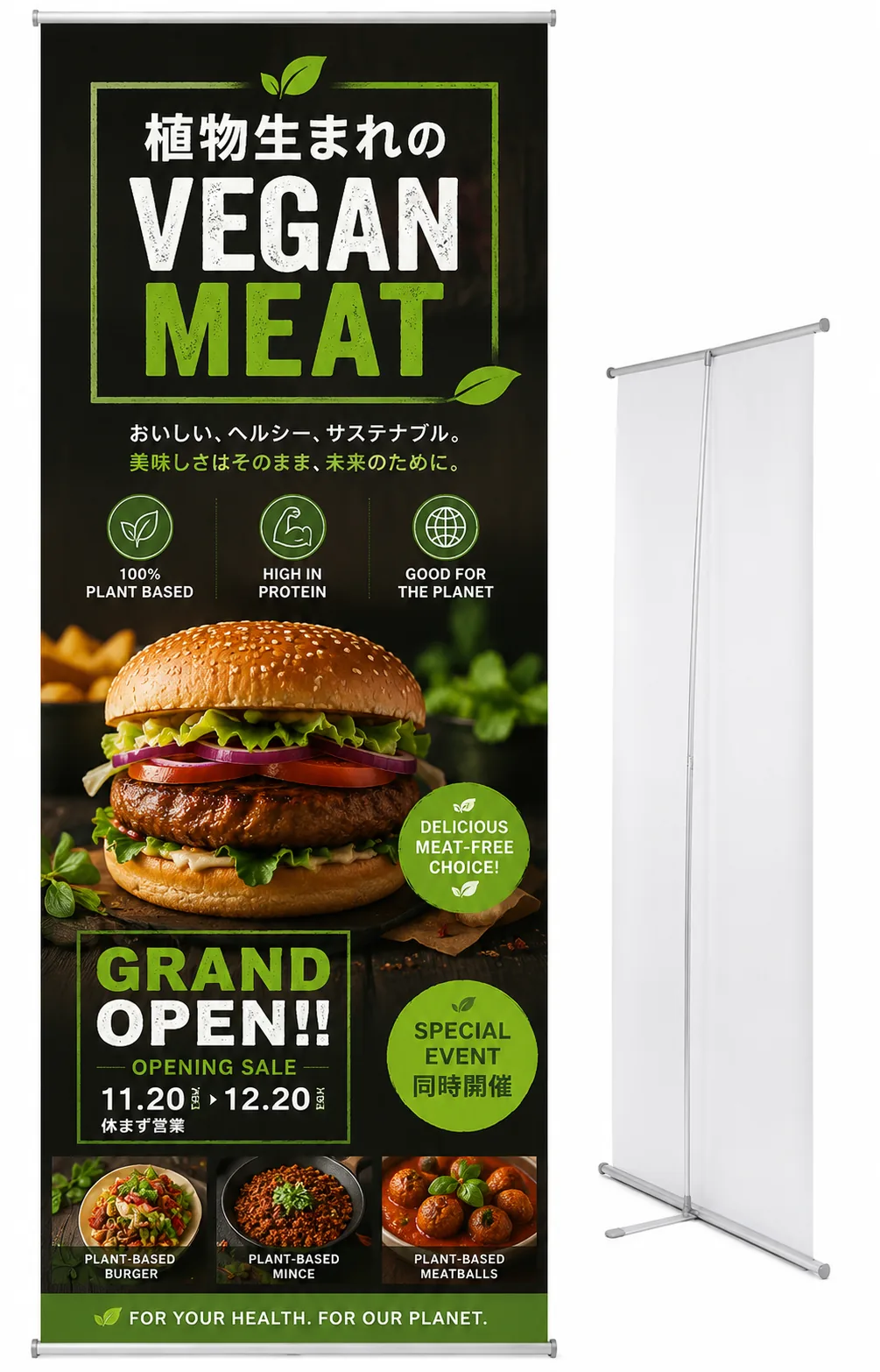
Best for: exhibitors who want a crisp, professional finish and a stand that won't wobble in a busy hall.
| Size | Price |
|---|---|
| W600 × H2000 mm | ¥21,691 |
Which one should you actually choose?
If you're not sure, start here. Take a roll-up if you'll reuse it, transport it yourself, or want the safest, most professional default. Take an X banner if budget is tight or you need a second and third piece of signage without doubling your spend. Take an I banner if your booth is narrow and floor space is precious. Take a T banner if you want maximum stability and a clean look for a larger graphic.
And if you're still unsure, send us your booth dimensions and we'll tell you what actually fits, rather than what's most expensive.
Sizes: the thing that catches overseas exhibitors out
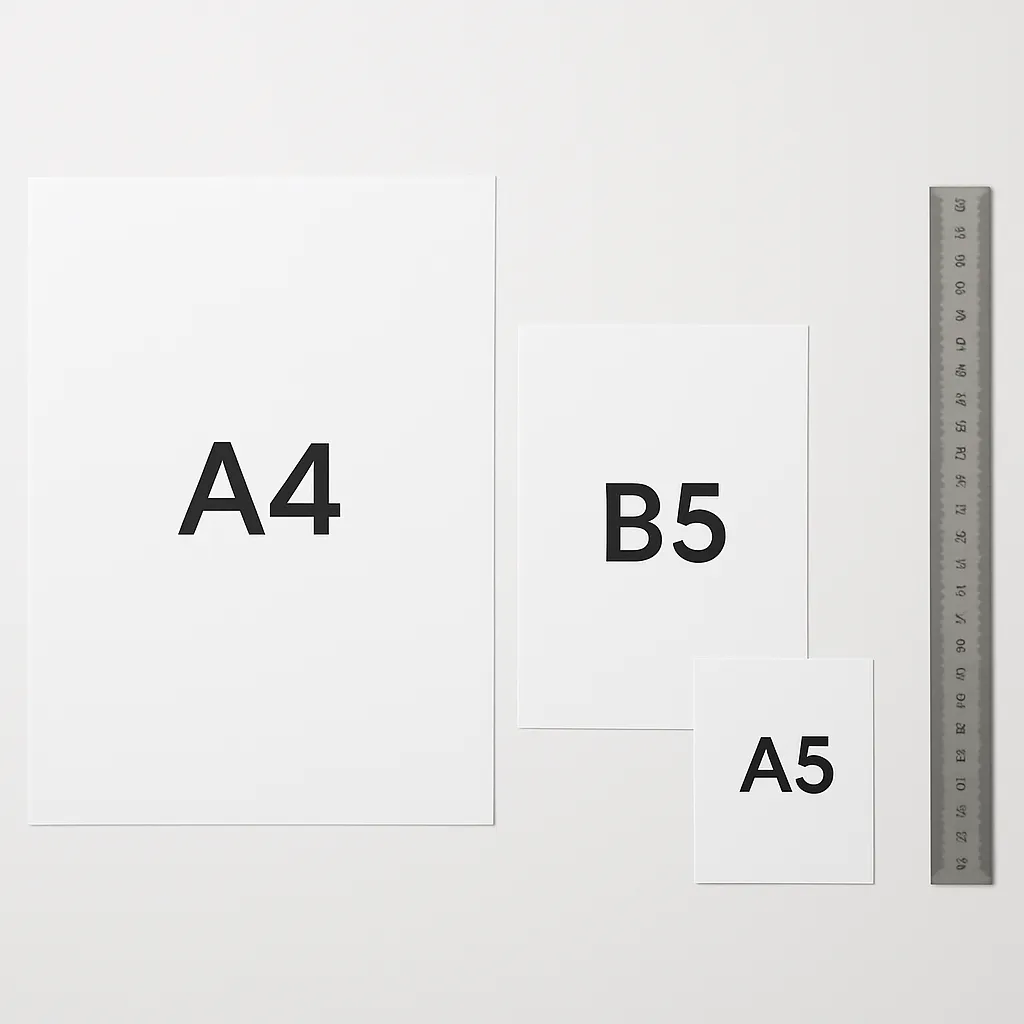
Japan uses the A series (A4, A5, and so on) that most of the world knows, so flyers and brochures usually translate cleanly. Business cards are the exception, as covered above.
The bigger trap is booth graphics. Your booth's dimensions come from the show organiser, and they're in metric, and they assume you know how Japanese booth structures are built. If you design a backdrop to a size that doesn't match your allocated space, you find out on setup day, which is the worst possible time.
The fix is simple. Get your booth dimensions from your organiser in writing before you design anything, and share them with your printer. A good printer will sanity check your artwork against your actual booth space before printing rather than after.
Delivery to your booth
This is the part that worries overseas exhibitors most, and it's genuinely the easiest part.
Your printed materials can be couriered directly to the venue and delivered to your booth, with your booth number on the delivery. You don't collect anything, you don't visit a print shop, and you don't carry banners through Tokyo on a train. You land, you go to your stand, and your materials are there.
Two things make this go smoothly. Share your booth number as soon as you have it, because it's how the delivery finds you inside a hall the size of a small town. And share your event dates and setup day, because deliveries need to land in the venue's receiving window, not before it and definitely not after it.
If you'd rather have everything waiting at your hotel instead, that works too. Some exhibitors prefer to check their materials over the night before rather than open a box for the first time on the show floor. Both are fine, just say which you want.
Deadlines: how far ahead should you order?
Here's a realistic timeline based on typical production times.
Business cards take about two to three business days to produce. Banner stands and larger booth graphics take about three to four. On top of that you need delivery time to the venue, and, most importantly, time to look at a proof. If you're right up against your show date, event banners are available with next day delivery.
The proof is the step people are tempted to rush, and it's the step that protects you. You'll receive a digital proof within one business day of sending your artwork, and nothing prints until you approve it. That's your last chance to catch a typo in your company name, a phone number with a digit missing, or a logo that's sitting a few millimetres off. Give yourself room to actually look at it properly.
As a rule of thumb, start two to three weeks before your show and you'll have a comfortable, unstressful run. Start a week out and it's still very doable. Start three days out and you're into rush territory, which brings us to the next point.
What if your event is next week?
Then ask, rather than assume it's too late.
Rush 24 hour printing exists precisely for this situation, and next day delivery is available on event banners. Last minute exhibitor orders are a normal part of the job. For more on rush delivery, see our guide to shipping banners to Tokyo Big Sight in under 48 hours. What you shouldn't do is quietly panic, decide it's impossible, and turn up to a show you've spent a fortune attending with no banner and 40 business cards.
Message with your event date and what you need. You'll get an honest answer about what's actually achievable, rather than a vague promise or a flat no.
Five mistakes overseas exhibitors make at Tokyo Big Sight
Not printing enough business cards. Bring double what you think you need. You will hand out more than you expect, and running out mid-show is a bad look in a culture where the card exchange opens every conversation.
English only materials. Your booth visitors are mostly Japanese. A leaflet they can't read is a leaflet they don't keep. Bilingual layouts change your return on the whole show.
Leaving printing until last. Booth, flights, and staff get booked months out. Printing gets remembered three days before, at which point your options narrow and your costs rise.
Designing to the wrong booth size. Get your dimensions from the organiser in writing, and check them against your artwork before printing, not on setup day.
Assuming you must buy printing through your event organiser. You can order directly, at transparent prices, and have it delivered to your booth or handed to your organiser on site. Many exhibitors don't realise this is an option.
Doing all of this without speaking Japanese
Everything above is straightforward when you can read the order form. The reason it feels hard from London or Chicago is the language wall, not the printing.
That's the whole reason Print Japan exists. You send your files and your booth details in English, on WhatsApp, from wherever you are. You get a clear quote and a proof back in English. If you don't have print ready artwork, our bilingual designers build it, including native Japanese typesetting so your materials read naturally to the visitors you came here to meet. Then it's delivered to Tokyo Big Sight with your booth number on it.
No Japanese, no print shop, no surprises on setup day.
Exhibiting at Tokyo Big Sight? Send us your booth details and event date on WhatsApp: +81 80-9062-3586
Or email hello@print-japan.com
Frequently asked questions
Can you deliver printed materials directly to my booth at Tokyo Big Sight?
Yes. We courier directly to the venue with your booth number on the delivery, so your materials are waiting when you arrive. Share your booth number and setup day when you order, and we'll time the delivery to the venue's receiving window.
How far in advance should I order printing for a Tokyo Big Sight show?
Two to three weeks before your show is comfortable. Business cards take about two to three business days to produce and banner stands about three to four, plus delivery time and a day to review your proof. Shorter timelines are workable, and next day delivery is available on event banners if your event is close.
What kind of banner should I get for my booth?
Roll-up banners are the safest default: quick to set up, easy to carry, and reusable at future shows. X banner stands are a cheaper option for secondary signage. I banner stands suit narrow booths where floor space is tight, and T banner stands give the most stability for larger graphics. Send us your booth dimensions and we'll advise on what actually fits.
What size are Japanese business cards?
The Japanese standard (meishi) is 91 by 55 mm, slightly different from typical US and European cards. It's the size professionals in Japan expect to receive, and bilingual English and Japanese layouts are common at trade shows.
Do I have to order printing through my exhibition organiser?
No. You can order directly and have your materials delivered to your booth, your hotel, or your organiser at the venue, whichever is easiest. Many exhibitors order their printing separately for better control over what they get and what they pay.
Do I need to speak Japanese to arrange this?
Not at all. You can send your files, booth details, and questions in English on WhatsApp, and get your quote, proof, and delivery confirmation back in English.
Need to print in Japan?
Get an instant quote or message us on WhatsApp. Everything handled in English.