Anime and manga have moved far beyond niche fandom. Today, anime-inspired visual style shows up on streetwear racks in Los Angeles, London, Tokyo, Berlin, and Sydney, worn by people who love the aesthetic — bold linework, dramatic color palettes, and a mix of futuristic cyberpunk and traditional Japanese imagery.
For custom apparel businesses, print-on-demand sellers, and streetwear labels, this represents a major opportunity. Anime-inspired T-shirt designs let brands tap into a visual language that is instantly recognizable, highly shareable on social media, and flexible enough to fit streetwear, gym wear, event merch, or limited-edition drops.
However, there is a crucial distinction that every serious apparel business needs to understand: anime-inspired does not mean copying copyrighted anime characters. It means drawing on the same artistic influences — Japanese art traditions, manga panel composition, cyberpunk cityscapes, *yokai* folklore — to create original artwork that has that unmistakable "anime feel" without stepping on anyone's intellectual property.
In this guide, we will walk through 10 original anime-inspired T-shirt design concepts your business can develop, explain why DTF (Direct-to-Film) transfer printing is especially well suited to this style of artwork, cover how to prepare your files properly, and explain the legal line between "inspired by" and "copyright infringement."
*(Please note: At Print Japan, we specialize exclusively in supplying commercial DTF (Direct-to-Film) transfers and heat transfer stickers for T-shirt business owners, print shops, and apparel brands who heat-press their own blank garments, rather than selling finished retail shirts or operating a cut-and-sew factory.)*
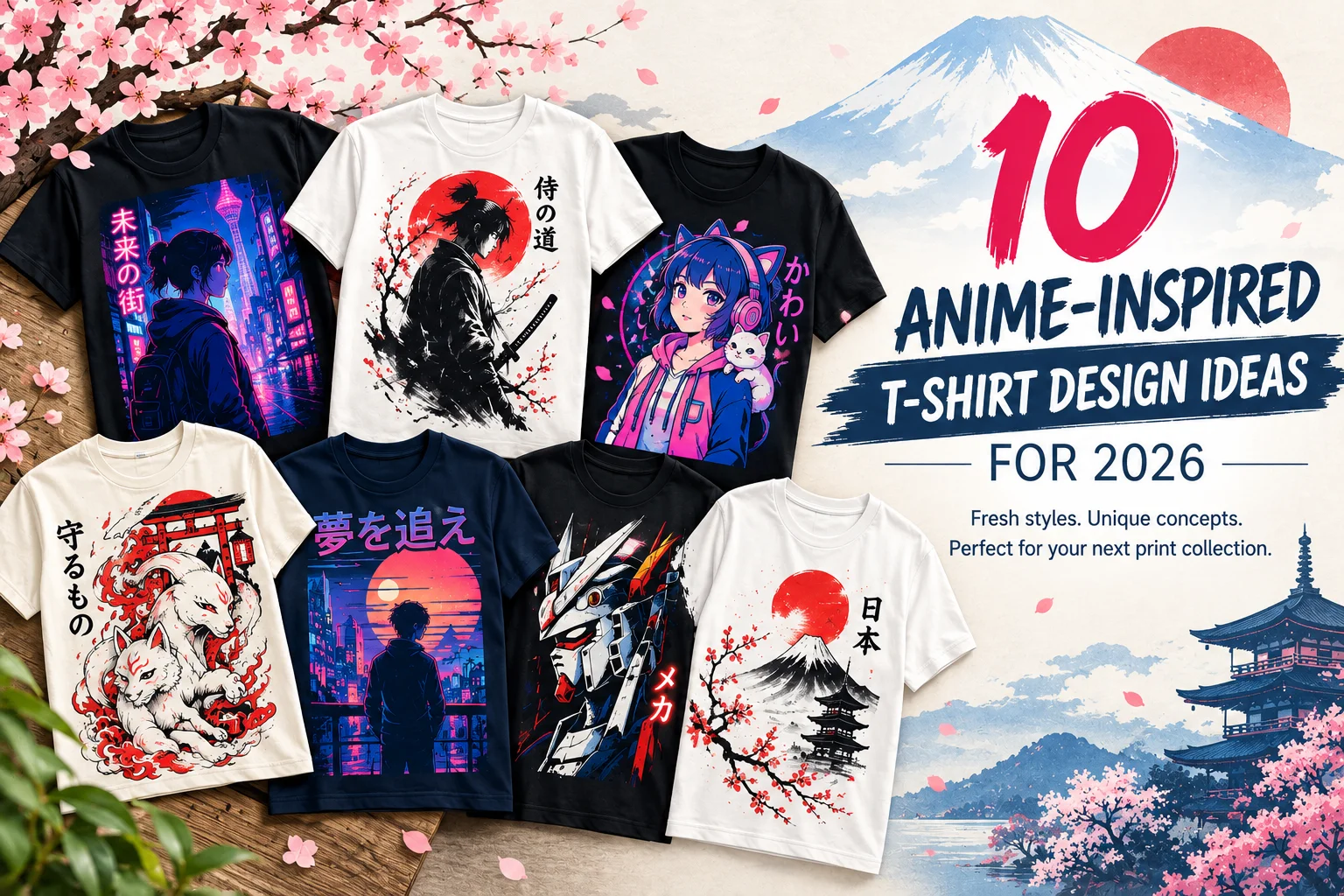
1. Cyberpunk Tokyo Streetscapes
The concept: A neon-lit cityscape inspired by Tokyo's Shibuya or Akihabara districts — narrow alleys, glowing signage (using invented shop names or abstract kanji, not real logos), rain-slicked pavement, and a lone silhouetted figure walking through it.
Visual style: High contrast, deep blacks with electric pinks, blues, and purples. Think dense linework combined with glowing gradient highlights, similar to the visual mood found in sci-fi anime films rather than any single copyrighted title.
Why customers like it: Cyberpunk aesthetics tap into a fascination with futuristic Japan that resonates strongly with international streetwear buyers, gamers, and sci-fi fans alike.
Best suited for: Streetwear brands, gaming merchandise, tech-culture events, and print-on-demand stores targeting a younger, trend-driven audience.
DTF printing recommendation: This design relies on glowing gradients and fine neon detail, which DTF transfers reproduce accurately even at small sizes — something traditional screen printing struggles with due to color separation limits.
Suggested T-shirt colors: Black or charcoal grey works best, letting the neon colors pop against a dark background.
2. Samurai-Inspired Original Artwork
The concept: An original samurai character (not based on any existing anime character) rendered mid-motion — cherry blossoms falling around a sword strike, or a calm, meditative pose beside a torii gate.
Visual style: Ink-brush inspired linework combined with modern digital shading. Muted, traditional color palettes (deep reds, indigo, gold) contrasted against a strong black outline.
Why customers like it: Samurai imagery connects with a broader interest in Japanese history and martial arts culture, appealing to buyers who want something that feels premium and artistic rather than "cartoonish."
Best suited for: Small clothing brands positioning themselves as premium or "art-driven," martial arts studios, and event merchandise for conventions or cultural festivals.
DTF printing recommendation: The fine brushstroke details and blended color transitions in this style benefit from DTF's ability to hold sharp edges alongside soft gradients in the same design.
Suggested T-shirt colors: Off-white, sand, or black — colors that let the ink-style artwork read cleanly.
3. Kawaii Original Characters
The concept: A cute, original mascot-style character — think a small animal, food item, or made-up creature drawn in a rounded, big-eyed "kawaii" style.
Visual style: Soft pastel colors, rounded shapes, simple facial expressions, and minimal shading. The emphasis is on charm and simplicity rather than complex detail.
Why customers like it: Kawaii culture has a dedicated, enthusiastic audience worldwide, and cute original mascots are easy to build a recognizable brand identity around — think of how many streetwear and lifestyle brands have grown around a single mascot character.
Best suited for: Print-on-demand sellers, lifestyle and stationery-adjacent apparel brands, and small businesses wanting to build a recurring "collectible character" line.
DTF printing recommendation: Because kawaii designs often use flat, simple color blocks, DTF transfers deliver clean, vibrant results even on small print areas like pockets or sleeves.
Suggested T-shirt colors: Pastel pink, baby blue, cream, or white — soft base colors that complement the kawaii palette.
4. Japanese Yokai-Inspired Creatures
The concept: An original creature design inspired by Japanese folklore — a fox spirit (*kitsune*), a mischievous forest spirit, or a shadow-like *yokai* — without copying any specific character from an existing franchise.
Visual style: A blend of traditional Japanese woodblock print (*ukiyo-e*) influence with darker, more atmospheric modern illustration. Textured backgrounds, bold outlines, and a slightly eerie but stylish tone.
Why customers like it: Yokai folklore offers a rich, largely untapped design space that feels authentically Japanese and mysterious, appealing to buyers interested in mythology, horror-lite aesthetics, and Japanese culture beyond mainstream anime.
Best suited for: Streetwear brands wanting a darker aesthetic, Halloween or seasonal merchandise, and designers targeting alternative or gothic-adjacent fashion niches.
DTF printing recommendation: Yokai designs often use rich textures and dark tones; DTF transfers handle deep blacks and subtle shading well, keeping the artwork moody rather than flat.
Suggested T-shirt colors: Black, dark green, or maroon to reinforce the folklore-inspired mood.
5. Retro 1980s/1990s Anime-Inspired Aesthetics
The concept: Artwork that evokes the look of classic VHS-era anime — think grainy textures, bold primary colors, chunky typography, and a sense of nostalgic sci-fi or mecha adventure, all built from original characters and scenes.
Visual style: Slightly desaturated color palettes, halftone or scanline texture overlays, and simplified character shapes reminiscent of older animation cel styles.
Why customers like it: Retro anime nostalgia is a strong trend among both older fans who grew up with 90s anime and younger audiences drawn to the "vintage" aesthetic through platforms like Pinterest and TikTok.
Best suited for: Vintage-style clothing brands, event merchandise for retro gaming or anime conventions, and print-on-demand stores targeting nostalgia-driven buyers.
DTF printing recommendation: The halftone and grain textures common in this style print with excellent fidelity via DTF, which reproduces fine dot patterns more consistently than traditional screen printing.
Suggested T-shirt colors: Faded black, washed denim blue, or mustard yellow to reinforce the vintage feel.
6. Japanese Streetwear Typography and Graphics
The concept: A design centered on bold Japanese-inspired typography (using original phrases, not copyrighted logos or brand names), combined with minimal graphic elements like a rising sun motif, wave pattern, or geometric shape.
Visual style: Clean, high-contrast layouts mixing kanji-inspired lettering (created originally, not copied from existing brands) with modern sans-serif Western type, similar to the layered typographic style common in Japanese streetwear.
Why customers like it: Typography-driven designs are versatile, easy to reproduce across product lines, and tap into the ongoing popularity of Japanese streetwear culture in global fashion.
Best suited for: Streetwear labels, small clothing brands building a text-based logo identity, and businesses producing seasonal drop collections.
DTF printing recommendation: Sharp typography with clean edges is one of DTF's strongest use cases, since the process holds crisp letterforms without the edge-blurring that can occur with other transfer methods.
Suggested T-shirt colors: White, black, or heather grey for maximum legibility and contrast.
7. Manga-Panel-Inspired Original Artwork
The concept: A T-shirt design laid out like a manga page — multiple original panels showing a short visual sequence, speed lines, and speech-bubble-style graphic elements (left empty or filled with original text).
Visual style: Black-and-white or limited color manga-style illustration, with heavy use of line weight variation, screentone-style shading, and dynamic panel composition.
Why customers like it: This format feels genuinely different from typical single-image T-shirt graphics and gives off an authentic "manga fan" appeal without referencing any specific copyrighted series.
Best suited for: Designers and small brands wanting a distinctive, conversation-starting product, and event merchandise for comic and manga conventions.
DTF printing recommendation: Fine linework and screentone-style dot shading print cleanly with DTF, which is important since this style depends heavily on line precision to read correctly at T-shirt scale.
Suggested T-shirt colors: White or light grey work best for black-and-white manga panel designs, keeping the linework crisp and easy to read.
8. Mecha-Inspired Original Designs
The concept: An original robot or mechanized armor design — not based on any existing franchise's mecha — shown in a dynamic pose, close-up detail shot, or stylized technical blueprint layout.
Visual style: Sharp angular linework, metallic shading, and often a blueprint or schematic-style treatment with grid lines and labeled parts (using invented terminology).
Why customers like it: Mecha design taps into a broad audience of sci-fi and gaming fans, and the "technical schematic" treatment gives it a unique look distinct from typical character-based T-shirt graphics.
Best suited for: Gaming and sci-fi themed merchandise, event merchandise for tech or gaming conventions, and brands wanting a more "engineered" aesthetic.
DTF printing recommendation: Metallic gradient shading and fine schematic linework both benefit from DTF's ability to reproduce detailed, high-resolution artwork consistently across print runs.
Suggested T-shirt colors: Black, gunmetal grey, or navy to match the mechanical, industrial tone.
9. Japanese Nature and Anime-Style Aesthetics
The concept: A nature-focused illustration — cherry blossoms, koi fish, Mount Fuji, or a bamboo forest — rendered in an anime-influenced illustration style rather than traditional Japanese art alone.
Visual style: Soft color gradients, dreamy lighting effects, and a blend of realism and stylization often seen in anime background art, applied to natural landscapes or elements.
Why customers like it: Nature-themed anime aesthetics have broad, calming appeal and work well for buyers who like the anime art style but prefer a more subtle, less "loud" design than character-driven graphics.
Best suited for: Lifestyle and wellness-adjacent apparel brands, small clothing labels targeting a more mature audience, and print-on-demand sellers wanting evergreen, non-trend-dependent designs.
DTF printing recommendation: Smooth gradient skies and soft lighting effects are reproduced accurately with DTF transfers, avoiding the banding that can occur with lower-quality printing methods.
Suggested T-shirt colors: White, sage green, or light blue to complement natural color palettes.
10. Minimalist Anime-Inspired Artwork
The concept: A single-line or simplified silhouette illustration — an original character's face, a symbolic object (a sword, a mask, a lantern), or an abstract representation of an anime-style scene reduced to its essential shapes.
Visual style: Minimal color use (often one or two colors), clean linework, and generous negative space, prioritizing a bold, recognizable silhouette over detailed rendering.
Why customers like it: Minimalist designs have wide everyday wearability, appealing to buyers who want a subtle nod to anime culture rather than a bold, all-over graphic.
Best suited for: Brands wanting a versatile, everyday product line, small businesses testing new designs with lower production risk, and businesses selling into markets where bold graphics may be less popular.
DTF printing recommendation: Simple, high-contrast artwork like this is fast and cost-effective to produce via DTF, making it a good choice for testing multiple design variations before committing to larger print runs.
Suggested T-shirt colors: Any solid color works, since the design relies on contrast rather than a specific palette — black-on-white and white-on-black are particularly effective.
---
Why DTF Transfers Work Well for Anime-Inspired Designs
Anime-inspired artwork tends to share a few characteristics that make it demanding to print well: full-color detail, fine linework, smooth gradients, and sometimes small text or intricate shading. DTF (Direct-to-Film) transfer printing is particularly well matched to this kind of artwork for several reasons.
- Full-color artwork without color limits: Unlike screen printing, which requires a separate screen for each color and becomes expensive and complex for multi-color artwork, DTF prints full-color designs in a single pass, making it practical for the vibrant, multi-tone color palettes common in anime-style illustration.
- Fine detail retention: Manga panel lines, samurai brushstroke textures, and mecha schematic linework all depend on sharp detail. DTF transfers hold fine lines and small text well, which is important for designs meant to be viewed up close.
- Smooth gradients: Neon cyberpunk lighting, soft nature-scene skies, and shaded character artwork all rely on gradients. DTF handles gradient transitions more smoothly than most screen printing setups, avoiding harsh color banding.
- Works on both dark and light garments: Because DTF transfers include a white ink layer, they print accurately on both black and white shirts without needing a different printing approach for each — useful for anime-inspired designs, which often look best on dark backgrounds.
- Practical for complex artwork: Detailed illustrations with many layers of shading and color transition, which would be very costly to reproduce with traditional multi-screen printing, are far more manageable with DTF.
- Well suited to small-batch and custom orders: DTF transfers don't require the setup costs associated with screen printing, making them a practical option for small clothing brands, print-on-demand sellers, and businesses testing new anime-inspired designs before scaling up production.
---
How to Prepare Anime-Inspired Artwork for DTF Printing
Getting good results from DTF printing starts with how the artwork file is prepared. Here is what apparel businesses and designers should keep in mind:
- 1Use High-Resolution Artwork: Artwork should be created or supplied at a minimum of 300 DPI at the intended print size. Anime-inspired designs often include fine linework and small details, and low-resolution files will lose crispness.
- 2Set Up a Transparent Background: DTF transfers print only the design itself, not a background block. Files should be saved with a transparent background (typically as a PNG) so the printed transfer follows the exact shape of the artwork.
- 3Choose the Right File Format: PNG files with transparency are generally the most practical format for DTF printing. For layered artwork, working in PSD or AI before exporting to a flattened PNG gives more control over color accuracy.
- 4Consider Color Accuracy: Anime-inspired designs often use saturated, specific colors — neon pinks, deep indigos, vivid oranges. Checking artwork in both RGB and a CMYK preview helps ensure colors do not shift unexpectedly.
- 5Preserve Fine Details, but Avoid Extremely Thin Lines: While DTF handles fine detail well, extremely thin lines (thinner than roughly 1-2 pixels at final print resolution) can become fragile during the transfer process. Slightly thickening the finest lines ensures long-term durability.
- 6Use White Ink Layers Strategically: For designs meant for dark garments, ensure light-colored elements rely on the white ink base layer to print accurately over dark fabric.
- 7Size Artwork Appropriately: Design elements should be sized with garment placement in mind — a full back-print cyberpunk cityscape needs different proportions than a small chest-pocket kawaii mascot.
---
Anime-Inspired vs. Copyrighted Anime Merchandise
This is one of the most important distinctions for any T-shirt business working in this space:
- Original anime-inspired artwork: Designs created from scratch drawing on general stylistic influences — line style, color palette, thematic elements like samurai, yokai, or cyberpunk cityscapes — without depicting any specific copyrighted character, logo, or scene from an existing anime franchise. This is legally safe to sell commercially because the artwork is original creative work.
- Fan art: Depicts specific existing characters. Selling fan art commercially without permission from the copyright holder generally infringes on that holder's rights, regardless of how the artwork is stylized or modified.
- Licensed artwork: Official merchandise created with explicit permission (and a licensing agreement) from the anime studio, publisher, or rights holder. This is the only legitimate way to commercially produce and sell merchandise featuring specific copyrighted characters.
Why this matters for your business: Selling shirts featuring unlicensed copyrighted characters exposes your business to takedown requests, marketplace account bans (Etsy, Amazon, Shopify), and potential legal action. Building a product line around original, anime-inspired artwork avoids these risks entirely while tapping into the visual style that makes anime culture so popular.
---
Why International Apparel Brands Partner with Print Japan for DTF Transfers
Japanese visual culture — spanning traditional art, contemporary streetwear, and anime-influenced illustration — has built a strong international following. For T-shirt business owners, print shops, and apparel brands worldwide who press their own garments, Print Japan offers:
- B2B Custom DTF Transfers & Heat-Transfer Stickers: Commercial-grade DTF transfer sheets and gang sheets ready to heat-press directly onto T-shirts, hoodies, and jackets.
- Full English Communication: Complete English customer support for custom transfer orders, artwork file reviews, transparency checks, and gang sheet preparation.
- Native Japanese Print Quality: High DPI precision with exact color reproduction, opaque white ink underbases, and durable wash-resistant fabric adhesion.
- Custom Print & Merch Capabilities: Complete branding support including custom leaflets and flyers for apparel drops, posters, and bilingual business cards or hangtags.
- Worldwide & In-Japan Shipping: Fast, reliable delivery directly to your workshop, store, or fulfillment center in Tokyo, Osaka, or anywhere globally.
---
Ready to Order Custom DTF Transfers for Your T-Shirt Brand?
Original, anime-inspired T-shirt designs give apparel businesses a way to tap into one of the most visually distinctive and popular aesthetics in fashion today — without the legal risk of using copyrighted characters.
If you are a T-shirt business owner, custom apparel brand, or print shop looking for high-quality DTF transfers and heat transfer stickers for your garment press, contact Print Japan to discuss custom transfer orders tailored to your production needs.
*Get started today: Request a Quote or message Print Japan on WhatsApp for direct support.*
Related guides and services:
- Leaflets & Flyers for Apparel Drops — promotional inserts and pop-up store flyers
- Custom Posters for Merch Displays — high-impact retail and event posters
- Business Cards for Apparel Brands — premium meishi and hangtag printing
- Foreign Entrepreneur Japan Print Checklist — essential printed materials for new businesses
Need to print in Japan?
Get an instant quote or message us on WhatsApp. Everything handled in English.