Picture the moment: you're handed a business card in a Tokyo conference room, and instead of running left to right like every card you've ever read, the text runs top to bottom, starting from the right-hand edge and marching toward the left. For half a second, you don't know whether to read it, rotate it, or just nod respectfully and hope you look confident. That half-second is exactly why this guide exists.
That's tategaki (縦書き) — vertical writing — and once you understand what it's doing and why, it stops looking like a puzzle and starts looking like what it actually is: one of the most quietly deliberate design choices in Japanese business culture.
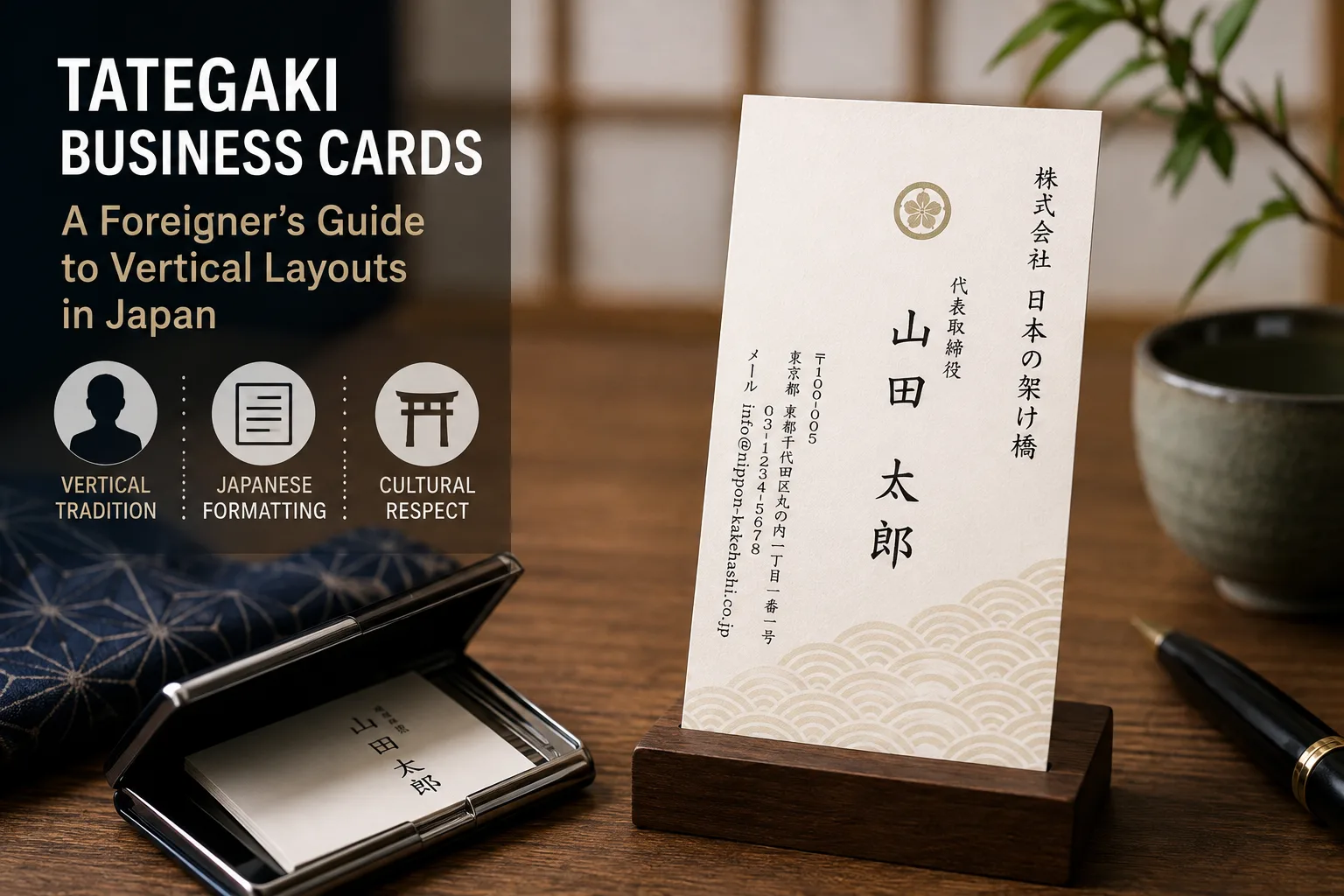
What Tategaki Actually Is (Japanese Vertical Writing Explained)
Tategaki (縦書き) isn't a stylistic quirk — it's the original direction Japanese was written in, inherited from classical Chinese script and carried forward through centuries of scrolls, calligraphy, and bound books. Characters stack top to bottom inside a column; columns then progress from right to left across the page. It's the same logic still running through most Japanese novels, many newspapers, and a good share of legal and ceremonial documents today.
Horizontal writing, yokogaki (横書き), is the newer arrival — practical for mixing in Western numerals and Latin text, and now dominant in casual, digital, and international contexts. Tategaki never went away, though. It stuck around specifically in places where formality, tradition, and gravitas still matter — and a Japanese business card (meishi — 名刺), it turns out, is exactly that kind of place.
Why Business Card Layout Matters in Japan
Here's the part most newcomers underestimate: choosing tategaki for your card isn't a font decision. It's a cultural signal, read and absorbed before anyone gets to your actual name or title.
A vertical business card in Japan communicates:
- Respect for tradition: Signals that you understand traditional Japanese business etiquette and cultural norms.
- Formality and authority: Preferred by conservative industries including law firms, government agencies, heritage finance, sake breweries, and ryokan.
- Attention to detail: Demonstrates that your card was custom-typeset by someone who understands local Japanese typography rather than generated from an automated Western template.
Show up to a formal Japanese board room with a horizontally laid-out card and nothing else wrong with it, and you haven't made a fatal error — but you've missed a free, subtle opportunity to establish respect before opening your mouth.
Anatomy of a Vertical Business Card (91×55 mm Japanese Layout)
Standard Japanese business cards are printed to 91 mm × 55 mm specifications. Once you know the vertical reading direction (top to bottom, right to left), the layout logic falls into place:
- Top-Right (Starting Point): Company name and corporate logo. This is the first element the recipient's eye touches.
- Center Column: Your full name, set in the largest font size on the card. Your job title typically runs in a smaller adjacent column directly to the right or left.
- Left Side (Ending Point): Company address, telephone number, email, and website URL — positioned on the left because it is the final column read in the sequence.
If that feels backward compared to a Western card (where contact details sit at the bottom-left), that's because it follows a completely different, equally coherent typographic convention.
How Numbers and Emails Work in Vertical Layouts (Tate-Chu-Yoko)
How do you fit Arabic numerals (0-9) and Latin alphabet letters inside vertical Japanese text? Japanese typographers solve this with two techniques:
- 1Tate-Chu-Yoko (縦中横 - Vertical-Middle-Horizontal): Short 2-digit numbers or abbreviations sit upright and side-by-side inside a single character-width box.
- 290-Degree Rotation: Longer strings such as phone numbers (+81 3-1234-5678), URLs, and email addresses are rotated 90 degrees clockwise so they run down the column sideways.
Understanding tate-chu-yoko is the hallmark of professional Japanese typesetting.
Common Mistakes Foreigners Make with Vertical Business Cards
- Applying horizontal layout logic — putting the company name on the left side instead of the top-right
- Leaving phone numbers and URLs un-rotated, causing ugly line breaks or awkward spacing
- Using modern sans-serif Gothic fonts on a vertical card intended to project traditional formality
- Incorrect furigana placement — furigana pronunciation guides on vertical cards sit to the right of the name column, not above it
- Using Western software tools that mangle Japanese punctuation marks and small kana (っ, ゃ, ゅ, ょ)
Should You Choose Tategaki or Yokogaki?
- Choose Tategaki (Vertical) if: You work in law, government relations, traditional finance, luxury hospitality, craft goods, or meet senior executives at century-old Japanese corporations.
- Choose Yokogaki (Horizontal) if: You operate in tech, startups, software, creative design, digital marketing, or work primarily with foreign subsidiaries and young companies.
When genuinely unsure, a double-sided bilingual card — horizontal English on the front, vertical or horizontal Japanese on the back — offers the ultimate versatility.
Getting Your Vertical Business Card Printed in Japan
- Work with a specialized Japanese printer: Generic Western design tools handle Japanese vertical text alignment poorly.
- Select Mincho (明朝体) typeface: The classic Japanese serif typeface is the natural pair for vertical layouts.
- Get native-speaker proofreading: Verify punctuation, small kana, and rotated numbers with a native Japanese proofreader before printing.
Print Japan provides full English-language support for bilingual business card printing across Japan — offering both vertical (tategaki) and horizontal (yokogaki) layouts with native proofing and fast 24–72 hour delivery. Message us on WhatsApp (+81 80-9062-3586) or request a quote.
Related products and guides:
- Japanese Business Cards — 91×55 mm meishi, vertical and bilingual layouts
- How to Write a Bilingual Business Card — name order and furigana rules
- How to Print Business Cards in Japan — sizes, paper stock, and translations
- Hanko and Meishi Explained — essential Japanese business tools
Need to print in Japan?
Get an instant quote or message us on WhatsApp. Everything handled in English.