In Japan, your business card — your meishi (名刺) — is doing more work than you'd think. It's your introduction, your credentials, and often the first real impression you make, all packed onto a card the size of your palm. Hand over one that's poorly formatted, hard to read, or clumsily translated, and you've sent a message before you've said a single word.
The good news: getting it right isn't complicated once you know the rules. Here's what actually matters.
1. Use Two Sides, Not One Crowded Card
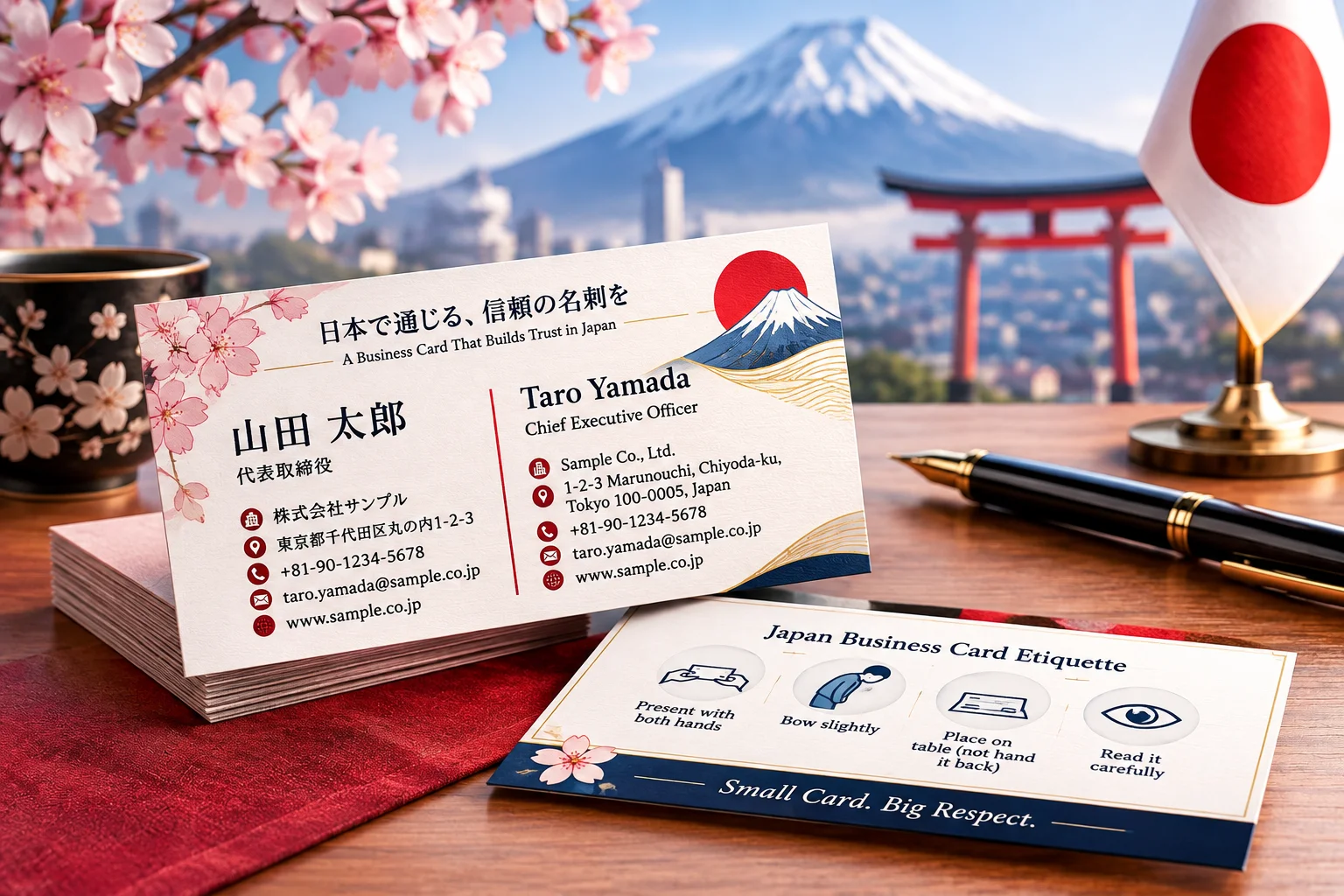
The gold standard for a bilingual meishi is simple: English on one side, Japanese on the other. Resist the urge to squeeze both languages onto a single face — it gets cramped fast, and it reads as an afterthought rather than something localized with care.
The two-sided format also does something subtle but useful: it lets you hand the card over with the right language already facing your counterpart, which is a small gesture of thoughtfulness that doesn't go unnoticed.
Some large multinationals issue separate all-English and all-Japanese cards for different contexts. For most people doing business in Japan, though, a well-made double-sided card is simpler — you only need to carry one type, and you're never caught without the right language on hand.
2. Pick an Orientation: Vertical or Horizontal
Japanese text can run two ways:
- Tategaki (縦書き) — vertical, read top to bottom, columns flowing right to left. The more traditional, formal look.
- Yokogaki (横書き) — horizontal, read left to right, same as English. Reads as more modern and casual.
Conservative industries — finance, law, government, manufacturing, established trading houses — often still lean toward vertical Japanese text on the reverse side. Startups, creative agencies, tech companies, and most foreign firms tend to use horizontal on both sides for a cleaner, matched look.
If you're not sure which fits your industry, horizontal is the safer default — it's simpler to lay out and doesn't feel stylistically split from the English side.
3. Get Your Name Order Right (This Is Where Most Cards Go Wrong)
Japanese names traditionally go family name first, given name second — no comma, no reordering. On the Japanese side of your card, follow that convention exactly: 田中太郎, not 太郎田中.
The English side is where things get murkier. Western convention puts the given name first, but that leaves Japanese readers unsure which name is actually your surname — a real problem when they need to address you correctly afterward. The fix used by many international businesses (and increasingly by the Japanese government for official English use) is simple: capitalize the family name, regardless of which order you choose:
- Taro TANAKA
- TANAKA Taro
Either works. What matters is removing the guesswork.
Two more details worth getting right:
- If your name uses kanji with an uncommon reading, add small furigana (a hiragana pronunciation guide) above or beside it, so people don't guess wrong when introducing you.
- If you're not Japanese, your name on the Japanese side should be written in katakana, not translated into kanji — unless you actually have a registered Japanese name.
4. Translate Your Title, Don't Just Dictionary It
Japanese job titles carry a lot of structural weight, and they don't map neatly onto English. 部長 (department head), 課長 (section chief), and 代表取締役 (representative director) each sit at a specific rung on a fairly rigid ladder — get the English translation wrong, and you can accidentally overstate or understate your seniority.
Rather than translating literally, use the English title your company already has on file for that role — HR or a Japanese-speaking colleague can usually confirm it. Then keep that title consistent across your card, your email signature, and anywhere else your name appears in English. Small mismatches read as sloppy in a business culture that pays close attention to titles.
5. Company Name and Address: Don't Translate, Restructure
Your company's name shouldn't be translated — use the exact Romanized version already in your official filings and website. 株式会社 (kabushiki gaisha) is conventionally rendered as "Co., Ltd." or "Inc.," so use whichever your company already has standardized.
Addresses need more than translation — they need restructuring. Japanese addresses run largest to smallest: prefecture → city/ward → district → block and building number. English addresses run the opposite way: building number → street → city → prefecture → postal code. Don't just swap the words in place; rebuild the order to match how each language actually reads.
6. Paper, Size, and Print Quality
A few physical details quietly signal how much care went into the card:
- Size: Standard Japanese meishi are 91mm × 55mm — close to, but not identical to, the US standard (3.5in × 2in). Use templates sized for Japan if you're printing locally.
- Stock: A slightly heavier matte stock reads as more refined than glossy or flimsy paper. This is one place where spending a little more is worth it.
- Simplicity: Japanese business card design tends to be clean and restrained. Your name, title, company, and contact details are usually enough — skip the QR codes, social handles, and mission statement.
- Proofreading: If you're not fluent in Japanese, have a native speaker check the Japanese side before you print a full batch. A typo in kanji, or the wrong level of formality, is a quiet credibility hit that's easy to avoid.
7. Quick List: Mistakes Worth Avoiding
- Machine-translating your title without a native check
- Skipping furigana for a name that isn't obviously readable
- Choosing thin, cheap stock in a market that associates card quality with respect
- Bending corners, or writing on a card in front of the person who handed it to you
- Letting your title drift out of sync between your card, email signature, and LinkedIn
8. Formatting Gets You There — Presentation Seals It
Even a beautifully formatted card can undercut you if it's handed over carelessly. A few basics of meishi kōkan (the card exchange) worth keeping in mind:
- Present and receive cards with both hands
- Offer your card with the text facing the person receiving it
- Take a moment to actually read a card you've just received before putting it away — don't pocket it straight off
- Never write on someone's card while they're still in the room
The Bottom Line
A well-made bilingual meishi is a small investment that keeps paying off, one exchange at a time. Getting the details right — name order, orientation, furigana, paper stock — is what separates a card that reads as *thoughtful* from one that reads as an afterthought. Before you commit to a big print run, get a proof in front of a native Japanese speaker or a local print shop that's made bilingual cards before. It's a five-minute check that saves you from quietly handing out the same small mistake a few hundred times.
Ready to get your bilingual business cards sorted? Print Japan handles everything in English — from design to delivery anywhere in Japan. Message us on WhatsApp at +81 80-9062-3586 or email hello@print-japan.com. Tell us about your trip, and we'll take care of the rest.
Related products and guides:
- Business cards — Japan-standard 91×55mm meishi, bilingual layouts
- How to print business cards in Japan — sizes, layouts, and title translations
- The Foreign Founder's Checklist — seals, registration, and business cards
- Hanko and Meishi Explained — Japan's essential business tools
- How to arrange printing in Japan before you arrive
Need to print in Japan?
Get an instant quote or message us on WhatsApp. Everything handled in English.